


 Polski
Bez kategorii
Imperfections can be perfect
Apr
Japanese Aesthetics is an art theory developed in Japan. As a field of knowledge, it appeared in Japan under the influence of the West at the end of the 19th century; today it is a science of two trends – defining the essence of beauty according to Western aesthetics and evaluating artistic work using traditional criteria. It is impossible to understand Japan’s aesthetic ideals without getting acquainted with the works of its ancient and medieval literary classics, which bear witness to the overwhelming role of nature, significantly influencing the socio-cultural life of this island country.
In the past, Japanese art writings dealt separately with the individual fields: poetry, drama, painting, calligraphy, music, tea ceremony, the art of flower arranging and garden design. Before and during the Heian period (VIII – XII centuries), art concepts were influenced by Chinese Confucian classics; the Middle Ages combined art with religion – all arts are in harmony with Buddhist teachings about the changeability of life, and art is a manifestation of a higher reality. In the Edo period (1603–1868), Japanese aesthetics was more diverse and humanistic, it definitely emphasized the importance of emotions in the process of creating a work by the artist and in its perception by the viewer. It was then that it became more important to present symbols than to realistically describe them. It was assumed that real art involves selective perception of beauty, avoids common things; The artist chose nature as his theme, avoiding describing everyday events in the lives of ordinary people. One of the favorite types of beauty was refinement and its variation – impermanence, that is, beauty that is delicate and fleeting; the secrets of nature could not be presented in a specific description, but only a suggestion – the more concise the suggestion, the better the effect.
When the ancient Greek, perceiving the changeability of the natural world, sought certainty and security in an ideal world, thus marking the centuries of cultural development of Europe, the Japanese – faced with powerful elements, on scraps of land torn from mountains and oceans – built his worldview based on on the concepts of fragility, vanity and transience to which philosophical and religious systems gave metaphysical character and power. Japanese connoisseur Donald Keene writes in his essay Japanese Aesthetics: “Perfection, like some inviolable area, is repulsive to the imagination because it leaves no room for its penetration.”
Hence the general avoidance of perfection, regularity and a perfect finish that would not allow the suggestion that further development is possible. The basis of the Japanese concept of beauty is infinite perfection, but impermanence, manifested by phases of growth and phases of decay, each of which is in the nature of incompletion. The condition of beauty is not to perpetuate it, but rather to suggest its fragility and passing away.
Noteworthy is the concept of shibui, also related to the ideas of unfinished and understated, here accompanied by certainty, peace and tranquility, resulting from the conscious use of ascetic models of restraint and simplicity. “In art, in most areas of culture, and in many everyday customs, we find the understatement of incompleteness. The shibui effect is perfect when it gives things a taste of inevitability and spontaneity as if things could not have a different nature. Incompleteness gives the viewer. the possibility of completing objects or activities with one’s own imagination. Shibui requires active perception of the observer. The reverse perspective of Japanese painting shows the observer becoming a participant. This allows for a better understanding of the Japanese love of imperfections and irregularities. ”
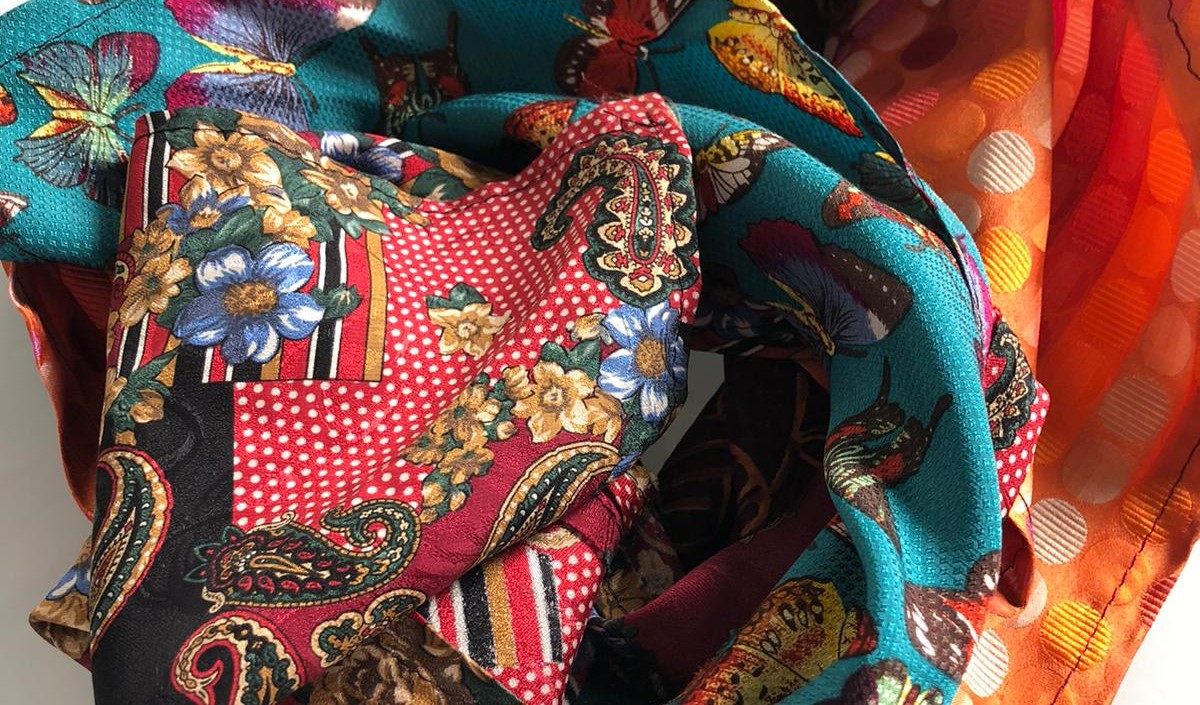
However, the highest aesthetic effect and at the same time one of the best known in Japanese art, defined as a typical feature of beauty, difficult to name, but present in every aspect of Japanese culture, is transience. It correlates with incompleteness and suggestion, with artistic understatement. All of this is contained in a Japanese word called yugen. The broadly understood Japanese art and culture, i.e. aesthetics, translates into all areas of life. This art is also used by Exprimere_te when designing and sewing clothes with the use of sashiko and boro embroidery. Inspired by Japanese aesthetics, we do not strive for perfectionism and perfection because we know that small shortcomings have their value and importance, they are needed in our life, style and thinking.
-Exprimere_te team